
Kada? // 12-15.decembar, 2024.
When? // December 12–15, 2024
Where? // Meštrović Pavilion, Trg Žrtava Fašizma 16, 10000, Zagreb, Croatia
This year, BelArt Gallery will be presenting itself for the first time at Art Zagreb, the international fair of contemporary visual arts, from December 12 to 15 at the Meštrović Pavilion, one of the masterpieces of Croatian architecture, built in 1938.
Art Zagreb was launched in 2018 and quickly established itself as the central event of the Croatian art market. Once a year, Art Zagreb showcases the best galleries and artists from Croatia as well as the region. This fair is a unique meeting place for gallerists, collectors, artists, curators, art historians, and art enthusiasts. As with all previous editions of Art Zagreb, this year a rich accompanying program will be organized, including a series of panels and lectures on topics such as the art market, issues of the secondary art market, the role of media in monitoring and promoting art, digital tools for audience development and gallery promotion, and more. Detailed information about the program is available on the Art Zagreb website link. At Art Zagreb, BelArt Gallery will present two artists from Novi Sad of different generations and artistic media, Bosiljka Zirojević Lečić and Aleksandar Stanojević Kemp.
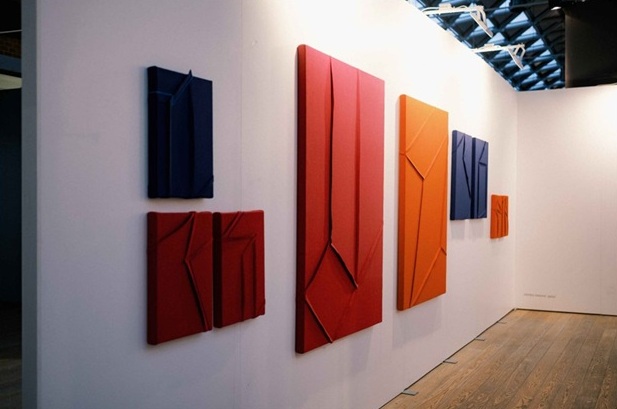
Bosiljka Zirojević Lečić (1971, Novi Sad) graduated from the Academy of Arts in Novi Sad in 1994, Department of Painting. She completed her postgraduate studies, also in the Department of Painting, at the same academy in 2000. She is a full professor at the Academy of Arts in Novi Sad, specializing in Painting. She has been a member of the ULUV and ULUS associations since 1995. Within the artistic group Multiflex, she collaborates with other artists on multimedia art projects. Since 1992, she has exhibited in over 120 group exhibitions, both in Serbia and abroad, and has held more than 20 solo exhibitions. She has received multiple awards for her artistic work. She coordinates several projects in the fields of visual arts and education. Her practice focuses on exploring the relationship between painting and other visual media, their parallels, and intersections. The relationship between internal and external space is a field where she investigates possibilities of expression and abstraction, using various materials and ideas, with the aim of connecting different media and fields, including art, ecology, urbanism, and visual culture.
The basic premise of my painting practice, over an extended period, relates to the need for constant experimentation with the very construct of the painting – the material from which the painting is “made.” Within an already established system of geometric, reduced forms that constitute my painterly expression, the surface of the painting—its pictorial value—is affirmed as yet another field of action and possibility for expression. Positioning the material/matter as a constituent element of the painting provides the opportunity to work and explore within an “expanded field of painting,” where certain properties of the used material offer the potential for developing a specific artistic expression.
The dominant material used in this series, Soft Vibrant Forms, is textile—specifically woolen fabric—which in the very process of creation becomes the material that “constitutes” the painting, effectively translating it into an object. By using textile as a constituent element, the painting’s support becomes primarily an area of the object-representation, endowed with certain specific qualities—softness, elasticity, tactility… In the organization of the painting-object’s space, geometric forms dominate, marked by joins (stitches) that interlock with one another. The joins are sometimes subtle and lightly indicated, while in other works they are robust and emphasized, thus creating a relief-like drawing that extends from the surface into space. The softness of the material itself, which forms the painting and constructs the composition, is contrasted with the rigidity of a linear drawing system that appears as a network of lines with a defined dynamism.
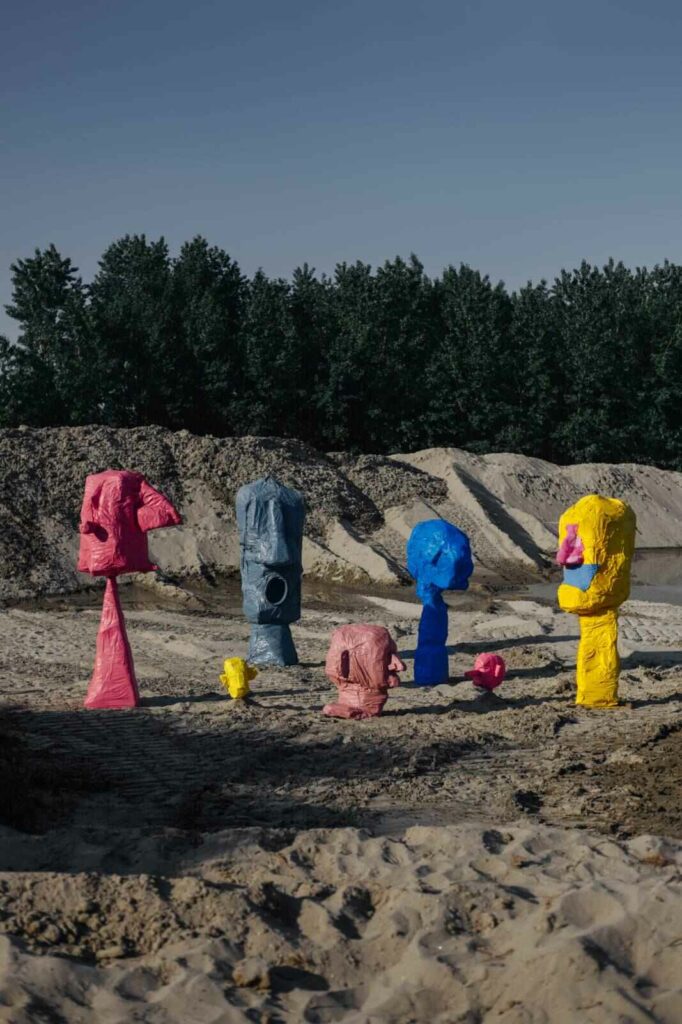
Aleksandar Stanojević Kempa (1992, Paraćin) graduated from the Academy of Arts in Novi Sad, Department of Fine Arts – Painting, in the class of Prof. Bosiljka Zirojević Lečić, where he is currently completing his master’s studies. He participated in the Summer Academy of Fine Arts residency program in Salzburg in 2015, as well as in a student exchange (ERASMUS PROGRAM) at the Facultad de Bellas Artes, Alonso Cano, Universidad de Granada, Spain, in 2017. So far, he has held over 10 solo exhibitions, along with numerous group exhibitions in Serbia and abroad. He is the recipient of the First Prize at the 44th “Palette of Youth” exhibition at the Fine Arts Gallery of the Cultural Center Vrbas. He has been a member of SULUV since 2021. Significant exhibitions include shows in Trieste, Timișoara, Paris, and Graz.
I characterize my work so far as an exploration and examination of different styles and techniques through the motif of portraiture, primarily using painting techniques, but also graphic, drawing, and sculptural methods. My interest in the human figure as a theme developed during my studies and through further research, practice, and progress. Over time, my main focus shifted to human-produced objects—everyday utilitarian items that, once used, become unwanted and discarded. In the series titled Mummification, I express an interest in three-dimensional objects in human form. The concept of the work, in creating the sculptures, is based on using discarded, non-artistic, utilitarian objects that are part of our everyday life. Through the high consumption and daily disposal of these items, I address consumer society, consumerism, and simultaneously explore the possibility of recycling to give new forms and values, changing the environment, function, and purpose of the discarded. I also focus on investigating how the non-artistic becomes artistic. The works are executed in mixed technique during the construction phase—by layering (gluing, attaching) various materials and forms (found objects), as well as through physical manipulation of the shape (breaking, bending). This method of constructing the work represents an inexhaustible source of new possibilities and forms. The new, abstracted form is then covered with various fabrics. The approach to technique evokes the Egyptian mummification of the human body. The color palette is based primarily on the use of intense shades and tones, referencing the synthetic and artificial, while also emphasizing transformation, turning an ordinary object into a form of aesthetic value. The portrait, as the main motif of this body of work, represents both the generator of waste and the primary consumer. The scale of these sculptures corresponds to the responsibility of the ordinary human on the planet.