
Marko Piroški – Archaeology of Self at the Gallery on Štrafta
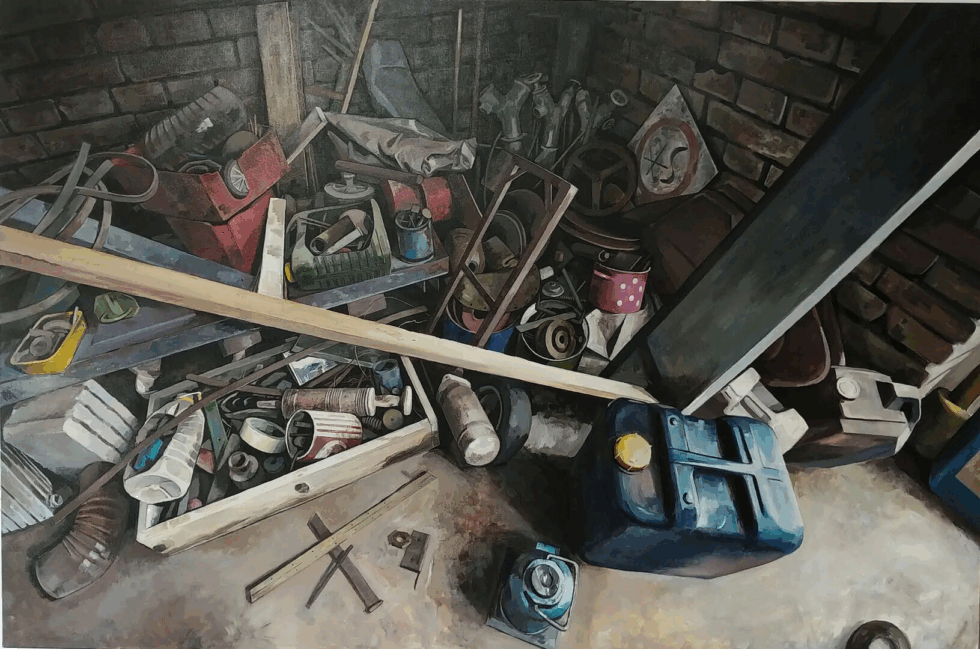
Sep 11, 2025 Exhibition Archaeology of Self by the young artist Marko Piroški, on view at the Gallery on Štrafta (corner of Mihajlo Pupin Boulevard and Pionirska Street). Archaeology of Self explores the complex relationship between the identity of one’s own past and nostalgia for bygone times through realistic still life painting. Focusing on the depiction of personal surroundings, particularly the rural household where I grew up, I find poetry in the captured state of chaotically accumulated, often forgotten objects through elevated perspective and a vivid color palette. These works are not only representations of space and things but also an introspective map—a means of understanding the self through the material traces of childhood objects. Using acrylic paints on large formats, I seek the beauty of the moment, believing that classical-academic expression still holds the power to communicate with the audience and convey what is both personal and universal. In the balance between chaotic and harmonious, each scene is a fragment of intimacy, containing a nostalgic sense of the carefreeness of my childhood and the transience of time—and within it, a recognition of one’s own past.Marko Piroški was born in 1992 in Novi Sad, originally from Srbobran. He completed high school at the Bogdan Šuput School of Design in Novi Sad in 2011. He earned his undergraduate degree in Fine Arts (Department of Graphic Arts) at the Academy of Arts in Novi Sad in 2021, in the class of Professor Zoran Todović. He completed his master’s studies in painting at the same academy in 2024. He has participated in several solo and group exhibitions. He is the recipient of the Milivoj Nikolajević Fund Award for Best Drawing-Study in 2018, as well as the Annual Award for the Most Successful Artistic Work in the Graphic Arts Discipline at his undergraduate diploma exhibition in 2021. Since 2024, he has been a member of the Association of Fine Artists of Vojvodina (SULUV) and works as an art teacher/professor in the municipality of Kikinda.
A Decade of the Danube Dialogues Festival: Between Shores Exhibition at the Salon of the Belgrade City Museum
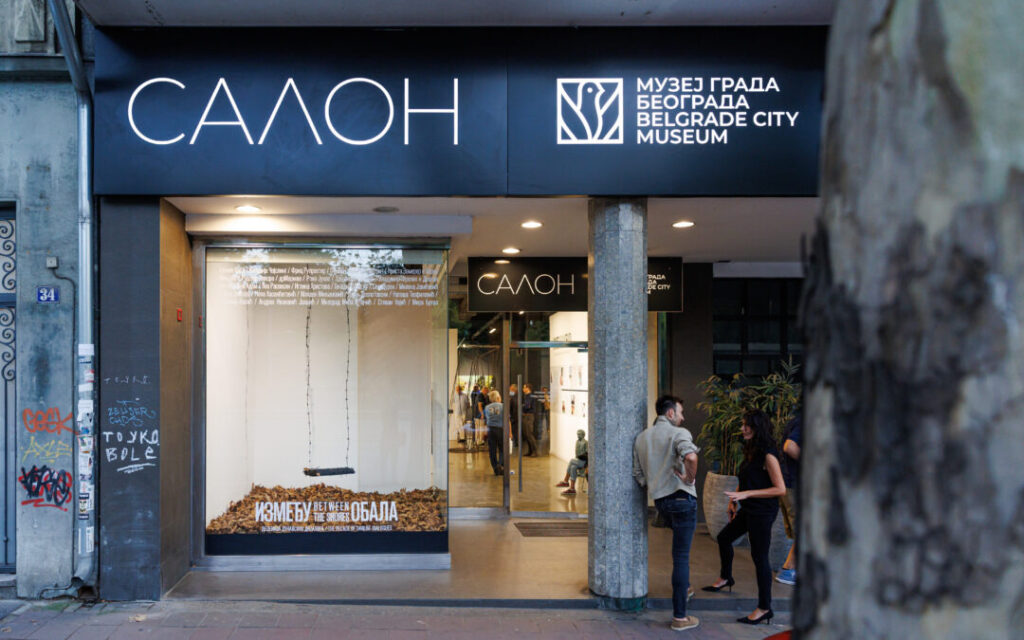
The exhibition Between Shores: Danube Dialogues 2013–2024 is open to visitors at the Salon of the Belgrade City Museum until September 8, 2025. Photo: Marijana Janković The exhibition Between Shores brings together 30 artists who, over the past decade, have shaped the identity of the Danube Dialogues-an international contemporary art festival in Novi Sad dedicated to connecting countries of the Danube macro-region: Germany, Austria, Slovakia, Hungary, Croatia, Serbia, Romania, Bulgaria, Moldova, Ukraine, Bosnia and Herzegovina, Slovenia, and Montenegro. In the spirit of openness and intercultural dialogue, the festival has occasionally hosted countries beyond the region, such as China and Japan, further expanding the network of artistic exchange and perspectives. “Between Shores is not only a spatial designation for rivers connecting the countries of the Danube basin, but also a liminal space-a place between the known and the unknown, the worldly and the spiritual, art and everyday life. In many mythologies, the river symbolizes transition: in ancient Greek tradition, it is the Styx-waters that separate the world of the living from the world of the dead, but also connect them as a place of change, initiation, and inner transformation,” explains the exhibition curator, Ksenija Marinković. In this spirit, the exhibition opens a space for memory and new dialogue, at a moment when we remember and pay tribute to Sava Stepanov (1951–2024), the long-time artistic director whose work shaped the festival’s mission. Reflecting on his last thematic impulse, the title Between Shores becomes a metaphor for life and artistic transition-a call to continue the dialogue that, like the rivers connecting us, endures even when physical presence ceases. Within the exhibition, selected works by the following artists are presented: Ulrike Kesl (Germany), Claudie Cheisling (Germany), Fritz Ruprechter (Austria), Franz Riedl (Austria), Eva Petrič (Slovenia/Austria), Kriste Zomerer and Lorena Minjon (Austria), Rudolf Sikora (Slovakia), DrMariaš (Hungary), Rok Juhas (Hungary), Zlatan Vehabović (Croatia), Vladimir Frelih and Dragan Matić (Croatian-Serbian artistic duo), Ana Adam (Romania), Lee Rasovski (Romania), Iglika Hristova (Bulgaria), Ghenadii Popescu (Moldova), Sam Duren (USA), Milena Jovićević (Montenegro), Tina Dobrajc (Slovenia), Nele Hasanbegović (Bosnia and Herzegovina), Mladen Miljanović (Bosnia and Herzegovina), Goran Despotovski (Serbia), Nataša Teofilović (Serbia), Čedomir Vasić (Serbia), Andrea Ivanović Jakšić (Serbia), Milorad Mića Stajčić (Serbia), Stevan Kojić (Serbia), and Mira Brtka (Serbia).
Slobodan Knežević Abi, Selman Trtovac i Ljubomir Vučinić: Mental performances
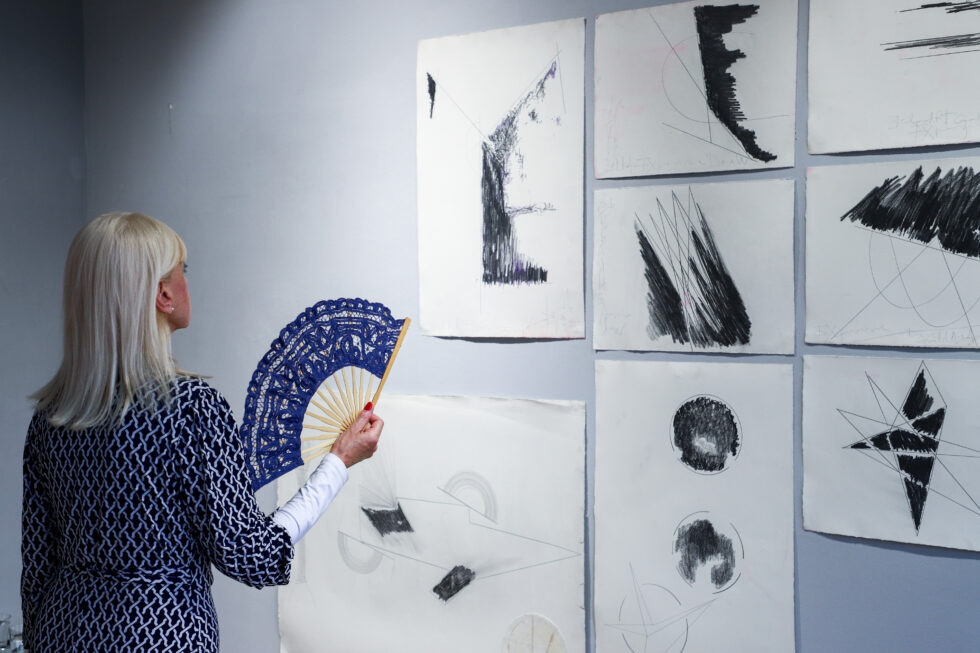
June 25 – July 22, 2025 Curator: Svetlana MladenovMental Performances is the first in a series of exhibitions dedicated to drawing, which BelArt Gallery plans to organize in the coming period. The series aims to showcase the complexity and contemporaneity of this discipline, the possibilities for its diverse treatment, and its constructive dialogue with space, techniques, and materials. Slobodan Knežević Abi, bez naziva Selman Trtovac, Linija za Savamalu Ljubomir Vučinić, Energy emission Drawing as the basis of almost every artistic exploration can be only a note, sketch, template, or study, but it can also be an autonomous work of art. This exhibition deals with drawing as an independent discipline that carries within it all the elements of a complete artistic process. The presented drawings are executed on paper and MDF, which can be classified as basic and classical supports. Through the works of three artists: Ljubomir Vučinić, Slobodan Knežević, and Selman Trtovac, the exhibition provides insight into different poetics and discourses as well as a shared affinity for abstraction. Treated in different ways, abstract form demonstrates abundance, often of unexpected possibilities. This exhibition reveals the spectrum of these possibilities: from expressive, through conceptual, to geometric abstraction. Respect for the line and love for it is what connects all three authors. By giving the line a special place in their investigations, they have opened a series of new possibilities in which the line assumes different roles, builds new worlds, or connects the incompatible. The drawings presented in the exhibition are based on the relationship of black-and-white surfaces (Knežević), black strokes and white backgrounds (Vučinić), with added accents of red (Trtovac). – Svetlana Mladenov Slobodan Knežević – Abi was born in 1948 in Bačko Dobro Polje. He graduated from the Faculty of Fine Arts, Department of Graphics, in 1977 and completed his master’s studies in 1979 in the class of Professor Marko Krsmanović. He is a member of ULUS and ULUV. From 1980 until retirement, he was employed at the Academy of Arts in Novi Sad, and from 1996 held the position of full professor for the subject Graphic Arts with Technology and Drawing with Technology. Selman Trtovac was born in 1970 in Zadar, SFRY. He began his formal art education at the Faculty of Fine Arts in Belgrade, where he studied painting from 1990 to 1993. He then continued his studies at the Düsseldorf Art Academy in the class of Klaus Rinke, where he received his Meisterschüler diploma in 1997. In 2003, he became a member of the International Art Guild (IKG). He is also the initiator and one of the founders of the Independent Art Association Third Belgrade and the artistic collective Perpetuum Mobile. He earned his doctorate in 2012 at the Department of Sculpture, Faculty of Fine Arts in Belgrade.Ljubomir Vučinić, born in 1956, completed his undergraduate and master’s studies in graphics at the Academy of Arts in Novi Sad with the project RESISTANCE-IMPRINT and the graphic portfolio COMPACTED, selected from the subject Visual Culture. He engaged in pedagogical work at the same institution as a professor in the specialized field of drawing. The author has been represented in selective and curated exhibitions presenting the contemporary art scene of Serbia both nationally and internationally, participating in relevant national projects, and has been awarded national prizes and recognitions for his authentic contribution to visual art.
Edita Kadirić – Balzam at X-Vitamin
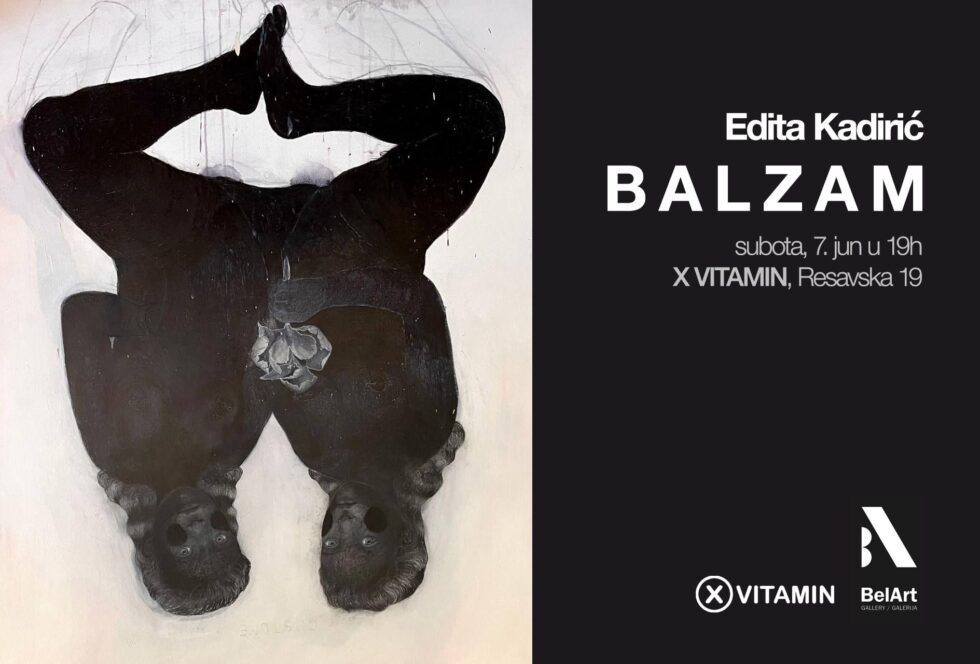
When: Saturday, 07/06 at 7 PM Where: X VITAMIN, Resavska 19, Belgrade Balzam is, for Kadirić, a metaphor for the eternally circulating and pulsating life in nature. It is an ancient liquid, alchemically elusive, changing in color, density, and volume. Sometimes it appears as a red pool of blood, a black tar-like puddle, at other times as a swirling river or shallow stream from which deer drink. The Balzam cycle is rich with black matter, a dense fluid that connects us to the past and the future, to other histories from which we too originated. From this matter, black beings emerge, which, according to the artist, refuse to accept other colors into themselves. This black, carbonized, moist cloud persistently carries its myths. Through these mysterious beings made of primal matter, the artist seeks to celebrate this brief time on Earth, the short inhale and exhale, life itself. – Senka Latinović Edita Kadirić (b. 1976, Banja Luka) is a visual artist whose work is based on exploring human recognition and discomfort through visual storytelling. She received her higher education in visual arts (Academy of Arts, Novi Sad; Faculty of Fine Arts, Belgrade; New Media and Artistic Production, Faculty of Fine Arts, Barcelona). She was a fellow at the Fabra i Coats Center for Contemporary Art in Barcelona. Her work has been awarded multiple times and supported for years by the Carmen Würth Collection. It is also part of numerous private collections and institutions across Europe and the United States. Kadirić has realized a large number of solo exhibitions (Würth Museum – Germany; Promgalerie – Germany; La Trastera – Spain; Museum of Contemporary Art of Vojvodina – Serbia; Contemporary Gallery Subotica – Serbia; Salon Otto Bihalji-Merin – Serbia, etc.), group exhibitions, and multimedia projects. Drawing serves as her starting point and closest medium, which she then expands into forms such as animation, painting, objects, theater, video art, and performance. She lives and works across France, Serbia, and Spain. Seria Pastorala (2), 2024, kombinovana tehnika/crtež na papiru Seria Blazam (6), 2025, kombinovana tehnika/crtež na papiru. The exhibition is presented in collaboration between BelArt Gallery (Novi Sad) and X VITAMIN Gallery (Belgrade).
Aleksa Mitrović – Inside the cage
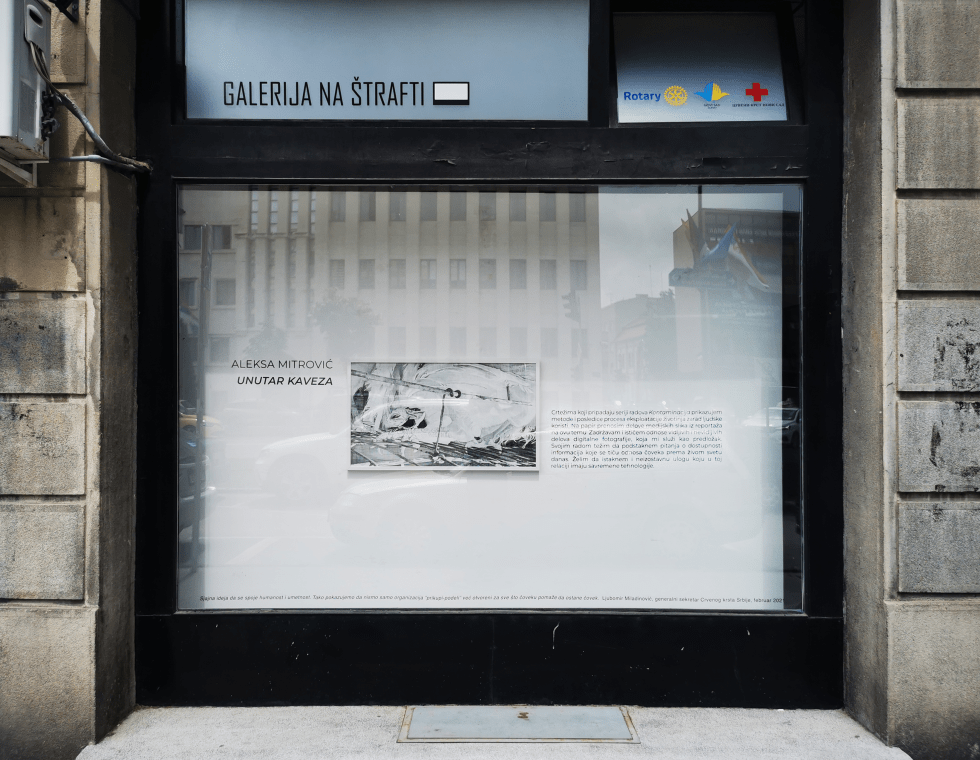
May 6 – June 20, 2025 at the Gallery on Štrafta The exhibition of works by young painter and new media artist Aleksa Mitrović is on display at the Gallery on Štrafta, at the corner of Mihajlo Pupin Boulevard and Pionirska Street. The work titled Inside the Cage, which explores the culture of animal exploitation and the consequences of contemporary technology that has rendered it invisible yet omnipresent in everyday life, can be viewed until June 20. “Through drawings belonging to the series Contamination, I depict the methods and consequences of the exploitation of animals for human benefit. I transfer fragments of media images from reports on this subject onto paper. I retain and emphasize the relationships between the visible and invisible parts of digital photography, which serves as my template. Through my work, I aim to raise questions about the accessibility of information regarding the human relationship with the living world today. I also wish to highlight the indispensable role that contemporary technologies play in this relationship.” – Aleksa Mitrović Aleksa Mitrović, born in 1999 in Ruma, Serbia, is a visual artist working primarily in painting and new visual media. He completed his undergraduate studies in painting at the Academy of Arts in Novi Sad in 2022, under the mentorship of Professor Vlada Rančić. He is currently a master’s student in painting at the same academy, studying under Dr. Lidija Marinkov Pavlović. He has held two solo exhibitions and participated in over ten group shows. He is a scholarship recipient of the Fund for Young Talents of the Republic of Serbia.
From the treasury of Vojvodina art
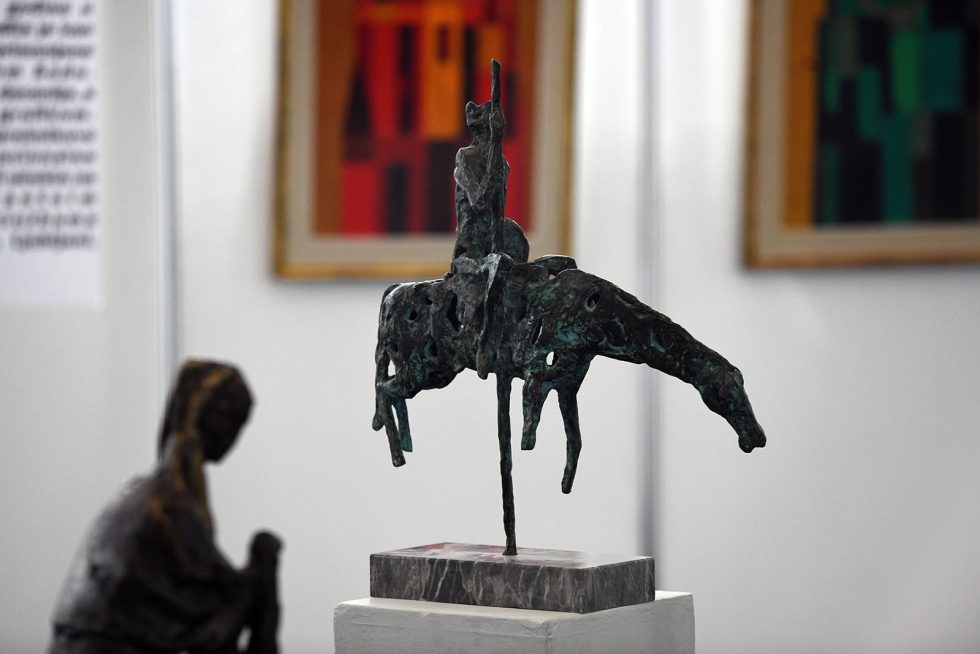
The exhibition From the Treasury of Vojvodina Art presented ten prominent Vojvodina artists who were active in the second half of the 20th century. Although nearly contemporaries, each of these artists left their individual mark on the Vojvodina art scene, anticipating a contemporary approach to painting and introducing local art into the modern currents of Yugoslav painting. Mar 24, 2025 The exhibition From the Treasury of Vojvodina Art presented ten prominent Vojvodina artists who were active in the second half of the 20th century. Although nearly contemporaries, each of these artists left their individual mark on the Vojvodina art scene, anticipating a contemporary approach to painting and introducing local art into the modern currents of Yugoslav painting. The eldest in the group of artists whose works make up this exhibition, Milan Konjović (1898–1993), is among the most prolific Serbian painters, whose oeuvre spans almost an entire century and left behind a series of anthological works. His artistic path included different phases, and all his characteristics were expressed through landscape painting. During his long creative life, he developed a recognizable style marked by strong colorism and an expressionist temperament. The exhibition also features the work of Boško Petrović (1922–1982), one of the most significant Vojvodina painters, whose creative engagement extended across various visual disciplines. In addition to easel painting, he worked with mosaics, drawing, watercolor, collage, and particularly focused on the promotion of tapestry. Another Vojvodina painter represented in the exhibition is Milan Kečić (1910–1998), whose primary motifs, alongside still lifes, were the plains of Vojvodina: fields, farmlands, and farms. The artist himself stated, “There is a world blind to the beauties of the plain, yet for the painter the plain offers itself in various forms. If he dares to paint only the bare, plowed earth and the high sky above it, that is for him the greatest challenge, a test for the demanding artistic struggle.” The painter and graphic artist Ankica Oprešnik (1919–2005), author of an authentic expression that critics described as expressive lyricism, stood out for her “specific treatment of surface elements, line, color, and the integral rhythm of graphic composition. Among the painters, the only sculptor whose work is represented in this exhibition is Jovan Soldatović (1920–2005), the author of imposing bronze sculptures, busts of notable figures, and numerous public monuments. The painter and graphic artist Milan Kerac (1914–1980), another creator from the first postwar generation of Vojvodina artists, went through all the phases and changes that marked visual art—from late Impressionism, colorist Expressionism, Fauvism, and abstraction to associative Expressionism. His work is characterized by a diversity of themes, motifs, and expressions. A frequent motif in his paintings was bulls; he remembered their eyes from his childhood and said that “between the whiteness of the horns and the sky, like rural embroidery, like a festive bouquet, the houses and above them the birds were united.” Another Vojvodina painter present in this exhibition is Stojan Trumić (1912–1983), a proponent of Expressionist painting and the author of numerous portraits of Vojvodina inhabitants, fields, farmlands, and village houses, characterized by intense color. The exhibition also features the work of Milivoj Nikolajević (1912–1988), a painter and graphic artist who, during his artistic development, moved from Post-Impressionism and Intimism to associative abstraction. Observing the branches along the riverbank, he was fascinated by the associations they suggested. In the work of painter Stevan Maksimović (1910–2002), critics noted the intertwining of refined lyricism with a certain strictness and measured approach in his geometrized forms. His landscapes and figurative compositions are not mere depictions of nature, but visual symbols and resonant metaphors, consistently realized throughout his entire body of work. Among the selected artists in this exhibition is Nikola Graovac (1907–2000), an artist with a rich pictorial oeuvre who cultivated colorist Expressionism. The artist himself stated that he painted as simply as he lived, with joy: “Painting is my rest, my necessity, the essence of my being. If someone were to take away my brushes and paints, I would cease to exist.” In the same spirit, the works of Mira Brtka (1930–2014) contribute a sense of playfulness and lightness to this exhibition through her monumental, simplified forms. The exhibition is completed by the work of Sava Halugin (1946), “Sava Šumanović’s Easel”, dedicated to the great artist after whom the visual arts award, presented by the Novi Sad Fair and BelArt, is named.
Circus – Ivana Brezovac / Mitar Terzić
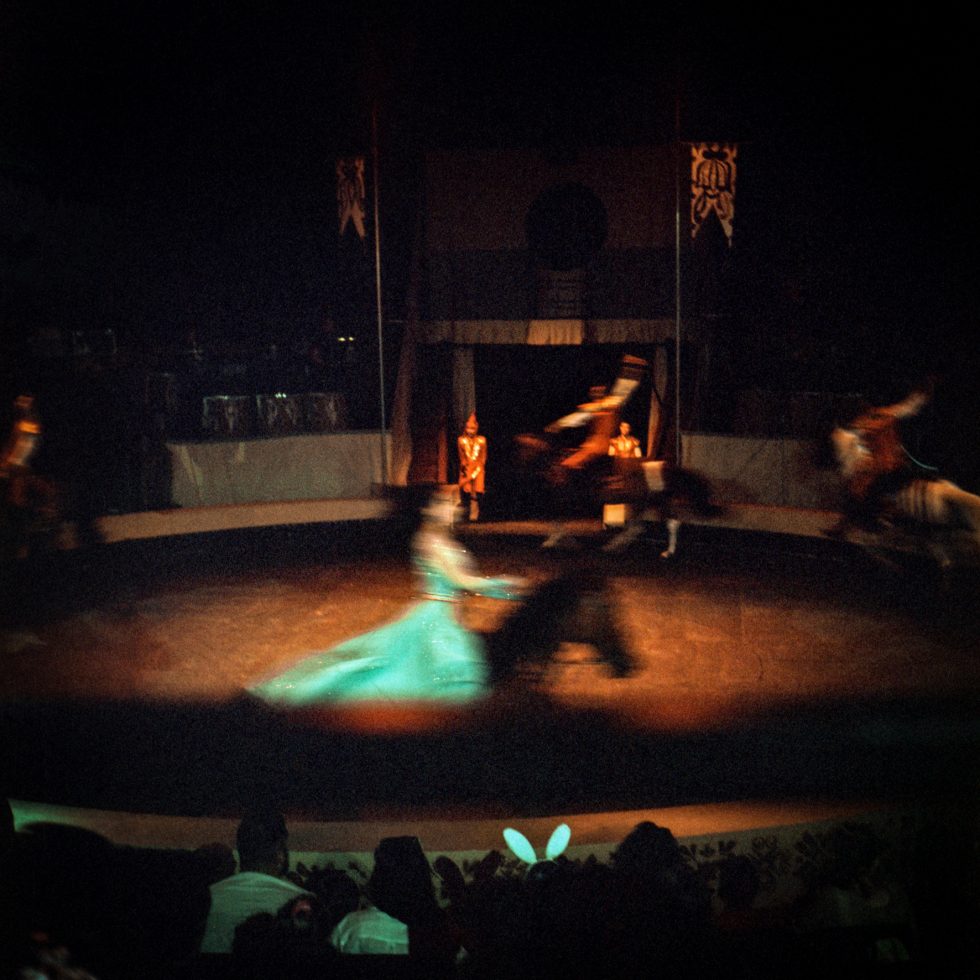
Joint exhibition of Ivana Brezovac (Serbia) and Mitar Terzić (Spain). Both artists explore the theme of the circus, each from their own perspective and personal experience. They work in traditional analog photographic techniques, and through this photographic dialogue, they aim to revive the almost-forgotten form of the circus, treating it as an authentic artistic expression and a source of inspiration for their own work. Through a form of poetic documentary and staging, they immerse us in the imaginary world of the circus, which is nothing less than a reflection of life and ourselves. Ivana Brezovac – Riding with the Wind The photographic series Riding with the Wind was created during an artistic residency at a state circus in Budapest, Hungary, in spring–summer 2023. The series consists of two parts: photographs of the performance and backstage, captured using analog color film, and a series of portraits of the performers in the show, shot on black-and-white film with a large-format camera. The circus world is depicted through two realities: one that sustains the imaginary and magical universe of the circus, where anything is possible, and the other, the real world, where we discover the actual people behind the masks and costumes-the “heroes” of the performance who push the limits of possibility. This duality of the imaginary and the real permeates the entire series, aiming to capture and convey the allure of the circus and its performers.“The circus is a mirror of reality in which we see ourselves exactly as we wish. An impossible universe that, under the spell of magic, appears as the only possible one where everything freely flies, unbound by gravity and materiality. The magic of the circus is rooted in the human need for abstraction and imagination. Strange, unusual people with superpowers and abilities expand the limits of understanding ourselves through their performances. This powerful show is filled with beauty, danger, uncertainty, expectation, fear, fun, and wonder. A mix of emotion and adventure offers one of the most intense experiences, where under the circus dome, for a moment, anything and everything is possible. We all become children again, with free minds and strong spirits that can easily ride with the wind.” (Author on the project) Mitar TerzićFreaks A series of black-and-white photographs shot using analog techniques with a group of circus performers in Alicante, Spain, during 2023. In an improvised studio and using masks created specifically for this project, acrobatic scenes were captured in which the performers’ bodies and the masks share equal significance. The performers’ bodies, in typical acrobatic poses and situations, bring each character to life, giving them a personality and symbolic meaning that the audience is invited to define. These imaginary circus scenes are complemented by a series of photographs of the circus environment, shot in an abstract manner as a reflection on the invented and imagined world of the circus. “I was about 12 or 13 years old when I saw Tod Browning’s 1932 film Freaks, which left an indelible mark on me. The actors in that film were real people with physical disabilities, who at the time were exhibited in circuses as attractions, and Browning sought them out across America for his film. In Yugoslavia, this film was shown under the title ‘Nakaze’. At that time, most films were about war or were Westerns, while Freaks was a real shock, especially for a teenager. Horror films were almost non-existent, and this film was banned in many countries due to the appearance of the actors. For me, the concept of the circus has remained inseparably tied to that film. Over time, circus performances have changed character, as has the film industry, and today that old film would leave a completely different impression. The meaning of the word ‘freak’ has also changed and today carries a very different connotation and usage. The idea of this series is to metaphorically, and using Browning’s film as a foundation, show that people with disabilities can sometimes achieve unimaginable goals. Encountering a group of young people working in circus arts inspired me to create this project and once again engage with Browning’s work.”* (Author on the project) Mitar Terzić – „Freaks“
Filip Najdanović – Within My Four Walls at Galerija na Štrafti
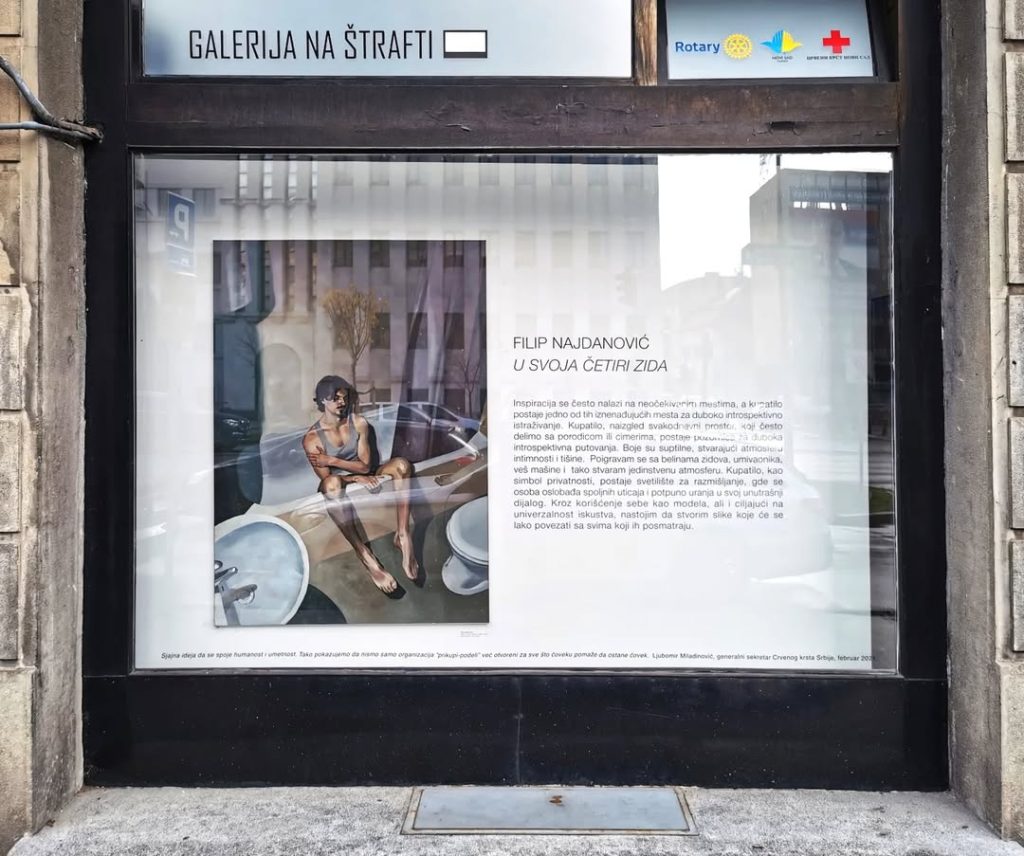
Filip Najdanović, born in 2001, grew up in Šid. He discovered early on that he had a talent for drawing and developed an interest in art. He completed his secondary education at the “Bogdan Šuput” School of Art, in the Graphic Design department. He is currently a fourth-year painting student at the Academy of Arts in Novi Sad. Since 2022, he has participated in numerous group exhibitions. In addition to painting, he explores sculpture and documentary photography. Inspiration is often found in unexpected places, and the bathroom becomes one of these surprising sites for deep introspective exploration. The bathroom, seemingly an everyday space often shared with family or roommates, becomes a stage for profound introspective journeys. The colors are subtle, creating an atmosphere of intimacy and quiet. I play with the whites of the walls, the sink, and the washing machine, thereby creating a unique atmosphere. The bathroom, as a symbol of privacy, becomes a sanctuary for reflection, where a person frees themselves from external influences and fully immerses in their inner dialogue. By using myself as a model, while also aiming for the universality of the experience, I strive to create images that can easily resonate with anyone who views them. (Filip Najdanović).
Kristina Pirković – DE PROFUNDIS at Galerija na Štrafti
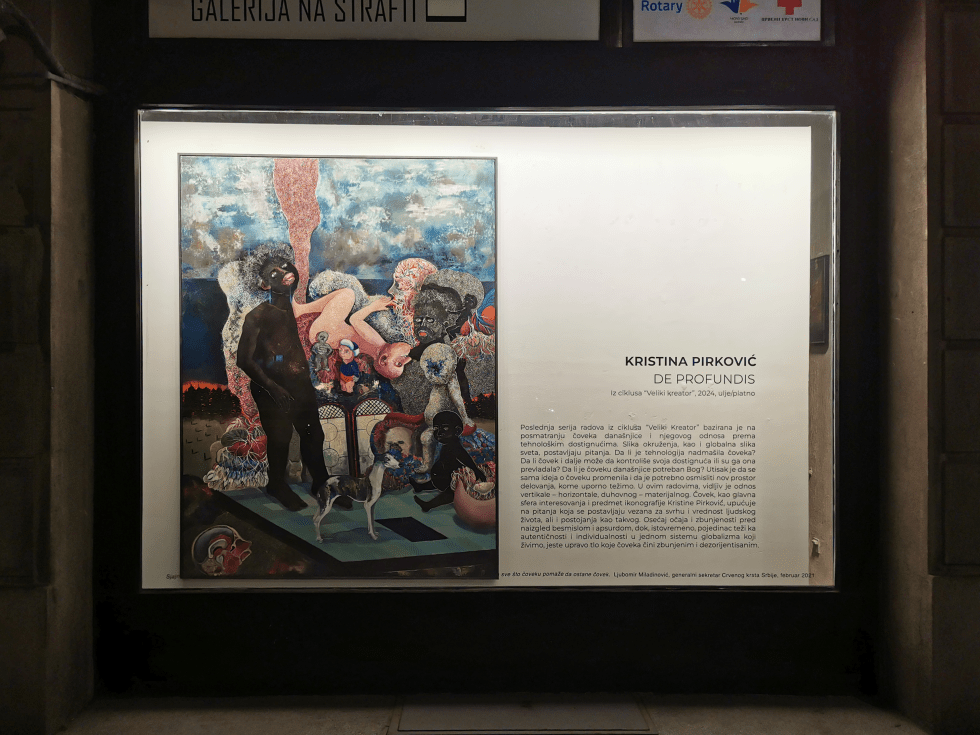
From February 14 to March 30, 2025, at Galerija na Štrafti, young Belgrade-based artist Kristina Pirković presents DE PROFUNDIS, a window into a rich mythology born from the need to understand the world, expressed in her latest series of works, The Great Creator, which is at once deeply personal and universal to humanity. The latest series of works, The Great Creator, which naturally continues her earlier cycle The Creation of Man, is based on observing contemporary humans and their relationship to technological achievements. The depiction of the environment, as well as the global picture of the world, raises questions: Has technology surpassed humanity? Can humans still control their own creations, or have they been overtaken by them? Does the modern human still need God? The impression is that the very idea of humanity has changed, and that it is necessary to imagine a new space for action-a space to which we persistently strive. In the latest works, the relationship between vertical and horizontal, spiritual and material, is clearly visible. Man, as the main focus and subject of Kristina Pirković’s iconography, points to questions concerning the purpose and value of human life, as well as existence itself. The feeling of despair and confusion in the face of apparent meaninglessness and absurdity, while simultaneously striving for authenticity and individuality within the system of globalism we inhabit, forms precisely the ground that leaves humanity bewildered and disoriented. (Kristina Pirković) Kristina Pirković (1991, Smederevska Palanka) completed her undergraduate and master’s studies at the Faculty of Philology and Arts, University of Kragujevac, Department of Applied Arts, specializing in Mural Painting, in 2014 and 2015. She has organized over twenty solo exhibitions and participated in numerous group exhibitions both in Serbia and abroad. She has been a member of ULUS since 2018. In 2024, she was a resident at the Cité internationale des arts in Paris, France. She has received awards for drawing, painting, and as the best student, notably the Second Prize for Drawing from the Vladimir Veličković Foundation (2021). She lives and works in Belgrade. Her practice primarily involves painting and drawing, while recently she has also been exploring sculpture.