
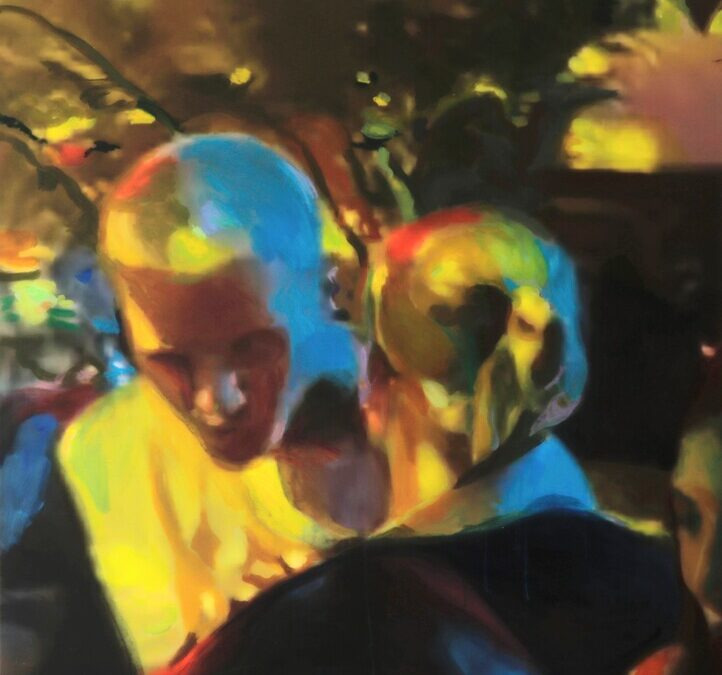
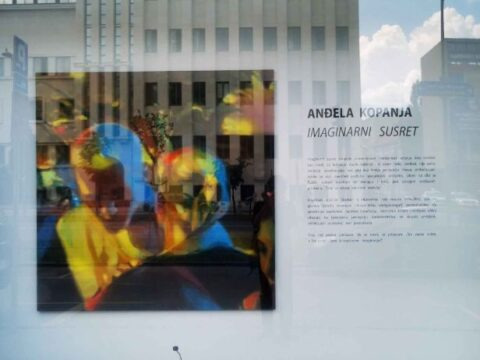
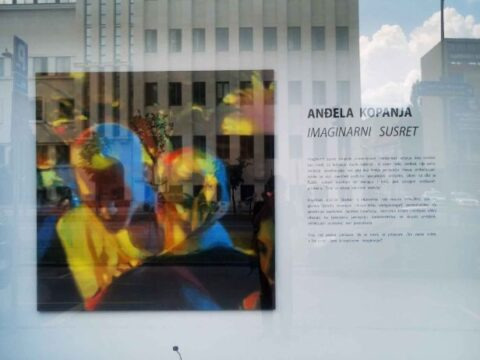
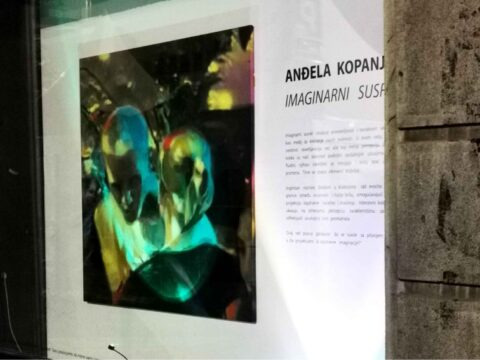
An exhibition by young painter Anđela Kopanja opened on June 17 at Galerija na Štrafti (at the corner of M. Pupin Boulevard and Pionirska Street). The work Imaginary Encounter will be on view until July 8, when Anđela’s concept will expand and move to the Galerija Akademije umetnosti u Novom Sadu as part of this year’s program of the EXP Projekat, with which Galerija na Štrafti collaborates within a network of exhibition spaces alongside the Kulturni centar Svilara and Šok Zadruga.
Anđela Kopanja (1998, Novi Sad) completed her undergraduate academic studies in painting at the Akademija umetnosti u Novom Sadu in 2021, and went on to earn a Master’s degree in painting from the Fakultet likovnih umetnosti u Beogradu in 2023. She is currently in the first year of her doctoral academic studies at the same faculty, where she recently acquired the title of Research Associate in Teaching.
She has presented her work in numerous group exhibitions and five solo exhibitions/projects. Among them, she highlights the group exhibitions Masterpieces IV at Galerija U10 and Zovem se sasvim obično at the Paviljon Cvijete Zuzorić, as well as the solo exhibition Just do at Galerija KvART BW and the solo project (Party) time at the Omladinski kulturni centar Opens. She was also a member of the organizational team of the Bijenale mladih (2022–23).
Anđela’s practice spans a range of media, including painting, photography, video, light installations, objects, and sound. She lives and works in Belgrade.
Alongside traditional and contemporary media, she often integrates collaborators from the field of music into her work. Through this approach, she seeks to encourage awareness and acceptance of dispersive reality as the only authentic reality in contemporary society. She draws inspiration from the atmosphere of nightclubs, within which she constructs individual concepts. In her previous works, she has addressed themes such as confronting everyday pressures and the capacity for conscious sensory activation through stimuli.
Through her work, she explores the interaction between the individual and their environment, evoking how the human mind and body respond to the dynamism of everyday life. She creates immersive installations, often situated outside gallery spaces, within industrial sites and nightclubs. By integrating traditional and contemporary media with elements from the musical sphere, she aims to activate multiple senses and deepen the viewer’s engagement. Her work frequently examines identity, the influence of contemporary society on the individual, and questions of insecurity, belonging, trust, courage, and intimacy.
She is currently working on the project “The Body in Transformation: From Risk to Adaptation,” in which she uses AI technology to explore reactions and transformations through the lens of the human body as an adaptive entity.
Anđela Kopanja
This exhibition is organized by BelArt Gallery in collaboration with the Crveni krst Novi Sad.
Interview with Anđela
Your works encompass different media and explore themes of interaction between humans and their environment, as well as sensory activation. How have these themes evolved throughout your artistic journey, from undergraduate to doctoral studies?
Themes related to everyday life have occupied my attention since the beginning of my undergraduate studies. My interest in analyzing my immediate environment developed naturally, out of a desire to engage with subjects that are close and familiar to me, so that I could remain consistent with myself and my creative process. Moving from Novi Sad to Belgrade before starting my Master’s studies brought personal changes and new perspectives.
During my Master’s studies at the Faculty of Fine Arts in Belgrade, I first encountered the theme of the nightclub. Today, I would define my practice as research into subthemes within the nightclub environment. This framework allows me to explore identity, the impact of contemporary society on the individual, and issues of insecurity, belonging, trust, courage, and intimacy.
In my work, I attempt to depict sensations that form part of a collective identity and use them as a basis for analyzing various subthemes. This thematic structure enables me to investigate deep and often contradictory aspects of human experience, while examining how contemporary society shapes and redefines individual identity and interpersonal relationships.
In addition to traditional and contemporary media, you often incorporate elements from the musical sphere. How do music and diversity contribute to the narrative you aim to create?
The integration of traditional and contemporary media contributes to a layered narrative, allowing exhibition visitors to connect with the work on multiple levels. By activating several senses, I aim to break down the barrier between viewer and artwork, creating immersive installations. Musical and audio elements intensify emotional and physical experience, enabling audiences to immerse themselves in an atmosphere that transcends the purely visual. Light installations manipulate space and create fluid images that encourage reflection on perception itself.
“Imaginary Encounter” explores themes of memory and identity through light and fluid imagery. Could you describe the conceptualization process and how it affects viewers’ perception of reality?
Imaginary Encounter poses a key question: “What do we truly see, and what do we project from our own imagination?”
Although painting is my foundation, I have always been interested in exploring what exists beyond the canvas. Light is not merely a tool for illumination but an equal medium that transforms perception. It symbolizes how susceptible our identities are to external influences—figures within the paintings become fluid, their identities shifting and dissolving under changing light conditions.
Inspired by nightclub atmospheres, I seek to evoke a space where the boundaries between reality and illusion blur. By creating an ephemeral experience, I aim to open space for reflection on one’s inner world.
You often present your work outside traditional gallery spaces, such as industrial settings and nightclubs. How does the choice of environment affect reception and interpretation?
I am interested in how operating beyond socially imposed norms can expand perspectives and reinterpret artistic boundaries. Presenting work in unconventional spaces allows me to observe how different environments shape the viewer’s experience. I describe my installations as environmental compositions—paintings become part of the scenography, while visitors become the main protagonists through their active participation.
Your current project, “The Body in Transformation: From Risk to Adaptation,” incorporates AI technology. What insights have emerged, and how does this project connect to your broader themes?
In both production and conceptual terms, I am guided by the awareness that I can only partially influence the final outcome, as visual information is generated based on my input. It was fascinating to see what kinds of worlds emerged from my earlier paintings. Using AI software to generate short videos from photographs, I created a new world—luxurious and exciting, yet unstable, uncanny, and perhaps even frightening—reminding me of our own reality.
The project will premiere at the Galerija Akademije umetnosti u Novom Sadu as part of the exhibition “Risk” organized by the EXP Projekat on July 8. During the opening, DJ Luka Beatović will perform ambient compositions, creating a dialogue between our works.
Looking ahead, what new directions or collaborations excite you most?
Although many possibilities excite me, optics has emerged as a priority. I would like to deepen my understanding of reflection and light-so if a physicist interested in optics and art is reading this, feel free to reach out! Thematically, I strive to follow a logical progression and remain an attentive observer. I believe I will continue exploring communication within society and between individuals in urban environments, particularly within the context of the club.